Showing posts with label green living. Show all posts

Tuesday, April 26, 2011

Down-Sizing

The south winds are blowing now, and even the insects have come in from the cold.

Praying for warmth.

When we bought the cheapest house in Wanganui, we knew we were getting a lot of space (110 square meters) for the money (less than a Ford F-150), but that NZ villas are notoriously cold and drafty.

Yes, this was our house in October.

A large house with high ceilings is a great asset for half of the year, but now that the equinox is behind us and we're closing in on the winter solstice, the amount of indoor space becomes a liability. So what I've been doing this week is cutting our losses. Heat loss, that is.

Yes, this was also our house in October.

While I've written about insulation and draft-proofing in previous posts, I have not yet addressed one of the simplest and most elegant forms of energy conservation in a home: shrinking it. I learned and lived this in Ladakh during the winter of 2006.


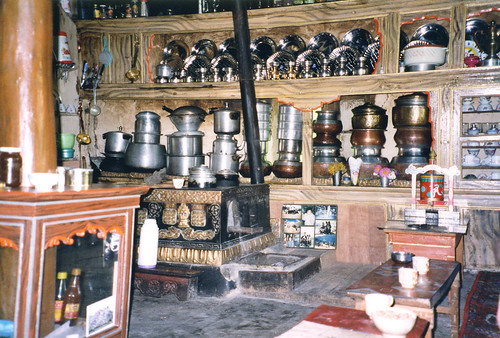
Ladakhis have big, beautiful houses, but they live in a desert at 3000 meters (9000 feet).


Traditional building in Ladakh was relatively cheap because houses were made mostly of earth and straw. Labor was cheap because your family and neighbors built the house with you.


But because of the cold climate, the entire house was used for less than half of the year. Fuel (dung or wood) is scarce in Ladakh, so during the winters the entire family lived in one room: the kitchen. Cooking also heated the living space while the rest of the house literally froze. Both eco and thrifty. Right on!

While we won't be restricting ourselves to the kitchen just yet, we have cut the size of our interior living space by 40 percent for the winter. Here's how:

Step 1: Frame a doorway in the central hall.

Step 2: Carefully install door purchased for $5 at local auction.

Step 3: Use leftover GIB around frame.

All that remains for step 4 is to paint and put up the trim. Step 5: curtains.

Note that we have cut off the south (poleward) side while we have increased solar gain on the north (toward the equator) side. The two large bedrooms on the south side where our interns John and Amy stayed over the summer are now secure storage for surf boards, bicycles and tools. These rooms will buffer our living space from the cold southern winds and provide dead air space (insulation). Also, they're a great space to store our great pumpkin harvest.


Come spring, we'll open the door again.


Peace and perspective, Estwing

Saturday, March 12, 2011

A Compost Tea for Plants

Aerated compost tea is becoming increasingly popular within organic gardening circles, yet producing such teas still remains a mystery to many. Here at the Eco School we decided to take on the challenge of brewing up a simple aerated tea as a way of adding beneficial microorganisms to the plants and the soil. We began our experiment with a 15 liter plastic bucket and an old fish tank air pump. In the bucket we suspended two cups of compost rapped in a loose-weave cloth and placed the aerator tubes at the bottom. The bucket was then filled with chlorine-free water. We set the tea outside with the aeration on for twenty four hours.
The number of aerobic microbes in the tea grows exponentially, reaching a peak in population in twenty-four hours. We used the tea immediately at full strength in our watering can to foliar feed the plants and inoculate the soil with microorganisms.
Commercial compost tea producers rely on laboratories to check for the proper numbers and types of microorganisms they have in their tea. We are going to rely on some well-made compost and a little luck. I have attached additional links for more reading about aerated compost teas below.

http://www.simplegiftsfarm.com/compost-tea.html

http://www.compostjunkie.com/compost-tea-recipe.html

http://www.soilfoodweb.co.nz/index.php?option=com_content&view=article&id=78&Itemid=56

Saturday, January 29, 2011

Beach Logging

I have been splitting quite a bit of wood for our two wood stoves over the past year and figured that leaving the rural lifestyle behind me and stepping into the suburbs for a few months might offer a change of pace. This dream came to an abrupt end with the three day rainstorm we had last weekend. The Whaganui river swelled into a churning brown monster laden with debris that were belched into the ocean. I thought twice before I took a swim in New Zealand’s agricultural run-off, but figured it was all part of the experience and plunged in. Over the next twenty-four hours the beach was transformed from a smooth black sand ribbon, laced with footprints and ATV tracks, to the remnants of a clear cut gone wrong.


Whole trees were washed up and stacked randomly amongst one another, leaving little room for my daily swim routine. So began my new career as a beach logger.


Nelson and I fire up our skidder and rumble down to the parking lot. Selecting only the finest wood for burning, we proceed to load the roof rack with logs of various sizes and up to eight meters long. Roping it all down, we headed for home.


The poor Subaru was riding low as we lumbered down the street, branches trailing close to the pavement. The four police cars we passed along the way seemed more concerned with catching hard criminals and drunks than busting us for doing a little beach clearing. Safely home, we unloaded without a scratch to the paint job. The wood now sits in a pile in the yard, awaiting the arrival of the multi-fuel stove and outdoor pizza oven.


-John the Intern

Editor's Note: John the Intern arrived to us, straight off a lobster boat in Maine, last Friday. He has been disappointed in the rainy New Zealand summer he's experienced thus far. But it beats the wintery thundersnows back home. He'll be in New Zealand until May, working with us and traveling to other sites. We've coerced him into writing some blog posts as part of his interning duties, so you can look forward to hearing more from him in the future.

Friday, January 7, 2011

Eating Us out of House and Home

There is an expression in permaculture that goes something like "You don't have too many snails, you have too few chickens".

Well, we don't have a snail deficiency, we've got a baby duck surplus.

Our ducklings have just about doubled in size in the week that we've had them. Part of the goal of having ducks was to have a protein source that we did not have to buy food for, making small gains in self sufficiency. We thought we had tons of snails. In fact we were crunching them underfoot walking up our driveway after a late night out two weeks ago. But the recent cairina moschata population boost has put a bit of a strain on our small backyard eco-system. Our normal go-to spots for snails have been picked dry by the need to feed our ducklings' insatiable appetite.

So, after some internet research we have begun improvising some snail traps. Most people use these traps to lure snails away from their garden beds. We are hoping they lure snails out of their summer hiding places, and into an easy collection point.

Here is an example of the bricks and damp cardboard method.

And here is the toilet paper tube cluster method.
From past experience we know that the beer method works well, but we're a little afraid of the effects of intoxicating our wee babies just yet.

Ducks cannot subsist on snails alone, even when they are eating 20+ per day. So we are supplementing their diet with another resource we had in abundance, seedy grass. We were using grass to line the bottom of the duck's inside home, an unused bath tub, and found that they really liked eating the grain from the tops of the grass. Thanks to a preoccupied scyther our yard was a veritable sea of waving amber grain, or as the duckies see it, a sea of food waiting to be harvested.

This is pretty perfect since every grain of grass seed is one more future weed waiting to invade our garden beds.

So far the ducks are proving their worth by ridding us of two potential problems, and converting them both to fertilizer. As William McDonnough says "Waste = Food", or in this case, waste = ... more useful waste.

Have you found any good waste = food solutions lately? Pass them on.

Thursday, January 6, 2011

A Mid-Summer Night's Dream

We like to watch old episodes of Grand Designs in bed. The program is highly entertaining, mildly educational, and somewhat addictive. Luckily our friend Tracy has all of the seasons on DVD and is happy to share them with us.


Over the course of watching the first two seasons I can recognize patterns that often form when couples tackle these types of building projects – particularly those that are renovations. Inevitably, the project goes over budget and over time, the couple gets stressed out, and the episode ends with host Kevin McCloud chatting with the couple by candle light in a drafty room because the house does not have electricity or windows yet.

Let me make it perfectly clear that we (now) have electricity and windows, and that our design is anything but grand. (When Kev wants to start ‘Humble Designs’ we’ll be first in line.) When we bought this property we inherited an existing consent for a renovation that included a large deck, verandah, and walk-in closets. We eliminated these but added solar hot water and insulation. That’s the way we roll.

Solar hot water and insulation are about as eco-thrifty as you can get. That is, you can save money and the planet simultaneously. Each one offers a return on investment greater than any term deposit in any bank. The point at which the savings from energy bills equals the purchase price is called the ‘payback period.’ After that, all of the additional savings are untaxed income: money in your pocket.

However, there is a caveat: you have to be able to afford them in the first place. If you can’t pay cash then you end up borrowing money, and the interest robs a part of your savings and extends the payback period. Although the US and NZ governments have schemes to help homeowners include energy efficiency measures, in most cases the result is more borrowing and more debt. (More on debt in a moment.)

In my opinion, the best approach governments could take would be providing zero-interest loans for insulation and solar hot water. These loans would act exactly like a cash purchase for the homeowner who could then repay the government through savings until the payback period is reached and then, as they say here, “Bob’s your uncle.”

While I have no idea why Kiwis use this phrase, I do have an uncle Bob. I do not, however, have a zero-interest loan. Therefore, I have dipped into my life savings to pay for insulation and solar hot water. This is an excellent investment because:

• Energy prices outpace the rate of inflation and there is every indication that this will only continue and even accelerate in the future. Any hedge against energy price rises is simply smart economically. The green benefits are a bonus.

• At the rate of quantitative easing (“printing money”) in the USA, my US dollars are becoming worth less and less everyday. Why leave them sitting in a bank losing value when they can be in my walls and on my roof adding value?

• New Zealand is not immune to debt either. This land of the long white cloud has significant debt issues on many levels that will come home to roost someday in the not-so-distant future. Whether that will look like Greece or Ireland I do not know. But something is bound to give.

• In a world that seems to be spinning out of control economically, environmentally and socially, it gives me peace of mind to have a tiny bit of control over a tiny property on a short street in a small city on a petite island in a big ocean.

We are not wealthy, but we have chosen to spend what money we do have on insulation and solar hot water for the reasons outlined above. We feel good about that decision, but it does not mean that we don’t stress out about going over budget and over time. After watching another uncompleted renovation on Grand Designs last night, I had terrible dreams that kept me tossing and turning in the summer heat.

I got up this morning, made myself a cup of coffee and started writing. I feel better now because I know we are doing this for all the right reasons. We are taking an abandoned house on a derelict section and turning into an urban homestead. We are sharing our story with anyone who wants to listen. And we are having fun doing it.


Peace, Estwing

Thursday, December 30, 2010

New Year - New Ducks

We have ducklings! Estwing took me on a surprise trip yesterday to the outskirts of town to pick up an early birthday present. We came home with a box full of chirping little pooh-filled dumplings of cuteness. I'll stop talking and get right to the pictures, since I know that's what you're after.


For now they're living in a bathtub in our future dining room.


We built them a pen outside, but they escaped. Cunning little buggers. We found them nuzzled up under the willow tree while a hungry cat lurked nearby. We'll have to modify it today to be a bit more duck proof.


Our ducks are Muscovy Ducks, which will grow up to be not too cute at all. But for the time being, they are ridiculous. For now they seem to just poop and eat and chirp at inconvenient times. But eventually they will help control pests in our garden, give us fertilizer, and provide us with edible eggs. Here's hoping we picked three females!

We have some names picked out already, but are open to suggestions. Any thoughts?


-June Cleverer

Wednesday, December 22, 2010

Oh Willow Tree

Did you know that willows can be coppiced? Did you also know that when placed in water or damp soil, a willow will resprout roots? We like to use the spanish term for this "pega-pega" ("stick-stick"), mostly because its fun to say.

Anyhow, my desire for a christmas tree this year led me to do a bit of experimenting with coppicing and pega-pega on the willow tree growing in the back corner of our yard. Of course you can't cut down a tree without a lumber-jacket on (I think I just invented a new word), even if it is 20 degrees Celsius.
I headed out bravely into what more closely resembles a junk yard than a wilderness. And after quick rendevous with a particularly overgrown willow branch...

I emerged triumphant. I allowed my trophy husband to pose with me and our harvested tree, because I think he's cute. I was feeling all merry, and humming christmas carols. Its a bit hard to get into the Christmas spirit when its hot and muggy out, but we were trying our best.


Earlier that day I had made some bundles of lavender harvested from the bush outside our front door.

I added these to a garland and angel I bought at Trade Aid and the bride and groom cake toppers my sister made us for our wedding.

Then we set the willow branch in a bucket of sand, and lacking placement options in our home-in-progress, decided to set it in a wheel barrow, for easy transport. Then, while belting out that song from "Love Actually" and listening to that rock and roll Christmas CD we used to listen to growing up. (You know, the one with Sting and Cyndi Lauper singing Christmas Carols). We decorated that bad boy.
And look! It's already filling up with presents.
As the kids at my day camp say... "Only 2 sleeps 'till Santa".


-June Cleverer

Wednesday, December 15, 2010

Active Solar

As you may recall, our first 3 design principles all had to do with passive solar design: solar gain (Let the sun shine in), thermal mass (Massticate on This), and insulation (Design Principle #3). Just this week we have decided on the solar hot water system that we will be installing. It is an active system, as opposed to our previous hot water system that was patently passive.

As you may have discovered in the previous posts, a certain level of vocabulary is required to speak accurately about eco-design. Passive and active solar are certainly two concepts central to eco-thrifty designing and building. The difference is quite simple, but if you find yourself talking to an architect, engineer or contractor one day about building a green home, make sure you know the basics so you can ask for what you want.

‘Passive solar’ refers to anything absorbing sunlight energy by simply sitting in the sun: a cat, a parked car, our house.

In new construction, passive solar strategies will pay for themselves in energy savings immediately. In renovation, the payback may take a little longer.

‘Active solar’ refers to a system with some moving elements. In terms of our active solar hot water system, the water is heated by the unit on the roof and flows into the house under pressure. It is actively being moved from outdoors to indoors.

The best data we can find is that the payback period of this system will be around 7 years. That represents a 10% return on investment. Which bank is offering a rate like that?


-Estwing

Tuesday, November 30, 2010

From off te grid to off te radar

Editors note: "te" is Maori for "the". Te Radar is a famous NZ comedian.

After living off the grid with solar electricity for 8 years on a 38 acre farm surrounded by thousands of acres of forestland, I thought moving to the ‘burbs’ would be simply cosmopolitan: mains power; postal delivery; bus service around the corner; fish and chips around the next corner; and fish and chips around the next corner and the corner after that.


While the bus and fish and chips are working out well, we have had significant trouble with the post and a minor disagreement with Meridian Energy over our first bill. One might think that putting up a post box on a certain street with a certain number would qualify one for mail delivery to that particular number on that particular street.


But one might be wrong. As we discovered, despite a neon-clad NZ Post pedal pusher passing our lonely #10 five days each week, we failed to receive anything in our newly painted post box except circulars which we specifically requested not to receive. Ah, I get it. Everything is reversed in New Zealand: different hemisphere, different lane for driving; fork on the right; toilet bowl flushes opposite. We should have written ‘No Letters’ and ‘Circulars Please!’ on the box. Of course!

Alas, after half a dozen phone calls, a visit to city council, the local post office and NZ Post Central Processing Wanganui, we…think we have it sorted, although we will not know for sure until the national database of postal addresses is updated next month. In the mean time, 10 Arawa Place in Whangarei is enjoying an abundance of wandering mail looking for a home, and our dispute with Meridian awaits resolution.

Our first paperless (that’s why we got it!) electricity bill came in at $144.56 for 510 kilowatt hours (kWh) of electricity. The good news is although the NZ household average electricity consumption is around 25 kilowatt hours per day, this bill represented our use as 16.5 kWh. The better news is that we actually used 0.39 kWh per day for a total of 12 kWh on the month. In other words, we were over-billed by 498 kWh or 98%. There appear to be only 3 possible explanations for this: the meter-reader is blind; the meter reader was intimidated by our high-tech meter box…


…or he/she – like NZ Post – simply could not find 10 Arawa Place, Castlecliff, and so Meridian simply billed us on estimated use.

Turns out the latter was, indeed, the case, and they have promised to send a human being to take an actual reading next month. Better work on the meter box before then.


-M.C. Estwing