Friday, May 20, 2011

Gathering Steam

The fifth monthly edition of the Wanganui Permaculture Gathering was held this week on May 18th (always the 3rd Wednesday) at the Whanganui Environment Base on Wicksteed Street.


The gathering is modeled after Permaculture Noosa's monthly meetings held on Australia's sunshine coast. They get upwards of 200 people at their meetings. I believe it is because of the simple format: 30 minutes of a mini-farmers' market; 30 minutes of a guest speaker; and 30 minutes of news, announcements, etc. That's it!


The model has worked well for us so far. Why not try it in your community? What have you got to lose?

This month's speaker was Jonah Marinovich from Wanganui's Green Bikes program.


Jonah, however, did not so much talk about Green Bikes, but about some interesting community activism projects he was involved with in Wellington. He provided an awesome story about creative, low budget resources access and (re)allocation.

We are tentatively looking for a speaker for the June 15th meeting and planning a Quiz Night fund-raiser for Green Bikes on July 20th. Please let us know if you can be a speaker or know of a venue to host the July Quiz Night.


Peace, Estwing

Tuesday, May 17, 2011

Takin' it to the Streets...er, Schools.

We are pleased to announce that the Eco-Thrifty Reno has busted out of Castlecliff all the way to Wanganui Intermediate School...
... and Wanganui High School.
At Wanganui Intermediate I am working with 18 classrooms to get the students thinking about using their own homes and sections as potential research projects for the upcoming science fair. The program is called, "The Science of Sustainability."


At Wanganui High I am working with a senior level sustainability course to look at the Eco-Thrifty Renovation as a "sustainability initiative." I have done two classroom presentations this week and tomorrow they come for a site visit.


If you know of schools, school districts, teachers or departments of education interested in high quality, practical, relevant sustainability education, please put them in contact with us at theecoschool@gmail.com


Peace, Estwing

Monday, May 16, 2011

Raising the Roof

National Public Radio told me this morning that the U.S. has surpassed its debt ceiling of 14.3 trillion dollars. And the most likely solution from Congress after some token bickering? Raise it. The unsustainability of that decision astounds me. It will not be long before the U.S. government will be selling public lands and national treasures to private entities as Greece is proceeding to do under pressure from lenders. (See previous two posts.)

Debt is dangerous.

I also heard on NPR this morning that student debt in the U.S. has surpassed credit card debt for the first time and will reach 1 trillion dollars this year. Again, astounding and unsustainable. As Mike Shedlock says, "What can't be paid back won't be."

A degree in ethnomusicology with $98,000 (US) in loans?!?

Meanwhile at Arawa Place this week we have finished replacing our roof with no intensions of raising it anytime soon.


And, although the ceiling in our lounge sags a bit, it is now insulated. We like it that way and have no intensions of raising the ceiling either.


Peace, and pay-as-you-go, Estwing

Friday, May 13, 2011

Oilier, Greecier...

It's been a long, busy week and will be another long, busy weekend. But in the spirit of making connections from the global to the local and from the unsustainable to the sustainable, I noticed that Greece and Oil and still in the news. This from Marketwatch, shows the top story for the day is, "Greece casts shadow over Street." And in the table on the right it shows stocks down but oil up.


And this next headline from the Wall Street Journal should make sense to anyone who's been paying attention to world events.


And so, here on Arawa Place we are trying to protect ourselves from the volatile effects of forces outside of our community. And we're cutting our carbon footprint in the process.

We are renovating an old house for energy efficiency and growing as much of our own food as we can. And we're sharing the experience with others. Today is an open house.

Drop by and check it out.

Peace, Estwing

Monday, May 9, 2011

Oil and Greece

I wrote about these topics a year ago on another blog, surf2survive, but they just don't seem to go away. We are a year on from the Greece bailout and in the midst of more volatile oil price gyrations: up nearly $6 U.S. today.

Source: Marketwatch

Meanwhile, Greece celebrates it's one year anniversary by preparing to sell state assets to pay back foolish German, French, British and U.S. banks who unwisely invested there chasing unrealistic returns.


Source: New York Times

I bring up these issues today because each one has implications for be eco-thrifty. First lets' take a look at Greece. Greece is all about living beyond one's means, going into debt, paying high interest rates, and then ending up with a liquidation sale. This, of course, is not unique to Greece. The pattern is repeated across the entire planet from Athens to Zimbabwe. In the beginning, living beyond one's means and going into debt appears to be thrifty because it costs very little to do so. But in the long run, debt is not thrifty. As the Greeks, Irish and Portuguese know, it can be extremely expensive.


Source: Guardian

Now oil. Put simply, oil prices will remain volatile for the foreseeable future while trending ever upwards to new record highs. This is simple supply and demand. As supplies run short and demand grows, prices rise. But extremely high prices cause "demand destruction" which sends economies into recession which brings prices down again temporarily. And then the pattern is repeated. To put things into perspective, here is a graph of oil production over a 2500 year period.
Source: Steve Mayfeld

Failure to invest in energy-saving products is also not thrifty. But again, in the short run may appear to be. For example, incandescent light bulbs are cheaper in the shop than compact flourescent bulbs. But in the long run they are much more expensive to operate. This is not thrifty at all. Nor eco for that matter.

So what do Greece and oil have in common? They both show us clearly that short-term thinking is expensive in the long run. Here at the ECO School we recognize that debt is dangerous. Inefficiency is dangerous. Being eco-thrifty means living within your means while investing everything you can into energy efficiency without going into debt. For example, we are looking at a 7% to 10% return on our solar hot water system.

Money where my mouth is: solar hot water, north-facing glazing, super-insulation.

We paid $3,900 N.Z. cash for it installed. Had we borrowed that money, most of our savings would go to the bank. I have said it before, the best way that governments (if they are serious) can promote citizen investment in renewable energy and energy efficiency is to offer no-interest loans. Otherwise, we just continue to make bankers richer.

And that's all I've got to say about that...for today, Estwing
Friday, May 6, 2011

Transformations

As farmland in the US is transformed into lakes and heathlands in England are transformed into charcoal, I thought we might highlight some positive transformations on Arawa Place. Recognize this image?


Now it looks like this.


And that old framing became...


...the back steps.

And some may recall an early picture of our lovely lounge...


...which now looks like this.


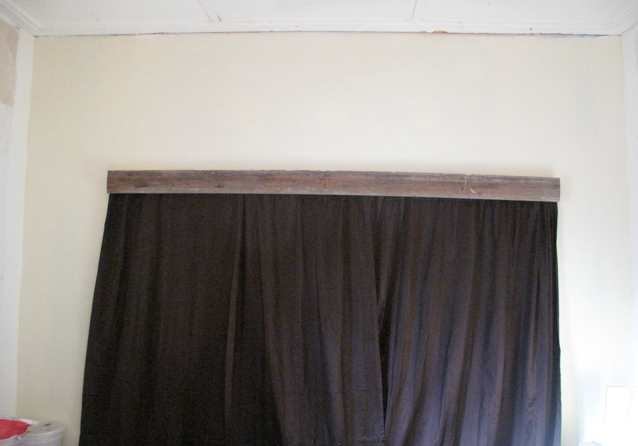
We removed all of the rotten studs and re-framed the entire wall, put in a new (second hand) window, and built a pelmet from a beautiful piece of native wood which had been a barge board on the exterior.

And with the curtains drawn.


Ah, the memories.


We've also started to transform some of the old rusticated weather boards...


...into pelmets. I find this one particularly attractive.


Ah, too many more images to show in one post. We'll post more soon. Until then, please go out and transform your world for the better.


Peace, and change we can believe in, Estwing

Wednesday, May 4, 2011

Hold the Brushes!

Thank you, Stacey, for commenting on the color scheme post. We have not yet made a decision. J.C. painted some swatches on the wall so we could get a better idea.


And then I brought over the flue for the Kiwiana coal range and one of the lead light cabinet doors.

Sample A

Sample B

And then we made a happy discovery. The gold curtains are not long enough to cover the French doors.


And we want to make sure that the French door curtains match those over the bench top which is along the same wall.


And so, the moral of the story is: Although the gold curtains were a good deal ($62 for 5 matching pairs), when compared to the time and effort and expense of painting, the formula changes. We can still use the gold curtains elsewhere in the house, or sell them on Trade Me. The key features of the kitchen will be: the Shacklock coal range, the lead light cabinet doors and the large hutch.


We will choose paint and curtain colors based on these three. Any suggestions?


Peace, Estwing