As the first bi-lingual contribution to our project, we have translated the first of our Passive Solar videos into Spanish (with the help of an amigo from Chile). Enjoy! or should I say Disfrutalo!
Showing posts with label solar. Show all posts
Showing posts with label solar. Show all posts
Tuesday, January 25, 2011

Tuesday, January 11, 2011
Solar Gain: Movie #2
Here's the second installment in our Passive Solar Series. In case you missed the first one, you can watch it here.
Enjoy!
Enjoy!
Wednesday, December 15, 2010
Active Solar
As you may recall, our first 3 design principles all had to do with passive solar design: solar gain (Let the sun shine in), thermal mass (Massticate on This), and insulation (Design Principle #3). Just this week we have decided on the solar hot water system that we will be installing. It is an active system, as opposed to our previous hot water system that was patently passive.


As you may have discovered in the previous posts, a certain level of vocabulary is required to speak accurately about eco-design. Passive and active solar are certainly two concepts central to eco-thrifty designing and building. The difference is quite simple, but if you find yourself talking to an architect, engineer or contractor one day about building a green home, make sure you know the basics so you can ask for what you want.
‘Passive solar’ refers to anything absorbing sunlight energy by simply sitting in the sun: a cat, a parked car, our house.

In new construction, passive solar strategies will pay for themselves in energy savings immediately. In renovation, the payback may take a little longer.
‘Active solar’ refers to a system with some moving elements. In terms of our active solar hot water system, the water is heated by the unit on the roof and flows into the house under pressure. It is actively being moved from outdoors to indoors.

The best data we can find is that the payback period of this system will be around 7 years. That represents a 10% return on investment. Which bank is offering a rate like that?
-Estwing
Saturday, November 13, 2010
Let the Sun Shine In
Free energy. No delivery charge. Service may be spotty in some areas.
As Meatloaf would say, “Two out of three ain’t bad.”
 Northeast corner of the house. What a beaut!
Solar gain is a major driver for this project and represents a significant amount of the financial outlay. Although we have decided against double-glazing for reasons that will be explained in another post, cutting windows into walls is made expensive because all framing, bracing and flashing details must meet the New Zealand building code. This is in addition to the cost of the glazing.
 Current wall = future french doors.
We are adding one window and French double-doors to the northeast corner of the house. (Remember we are in the southern hemisphere, and the sun is to our north.) The window will provide morning rays to the breakfast (i.e. coffee) nook, and the doors will flood the dining room with afternoon sun. My next two posts will explain how we plan to absorb (thermal mass) and retain (insulation) those lovely, free photons.
 Enjoying a cuppa in the sunny coffee nook.
For the window we went with second-hand, but the new doors have just been ordered from the local aluminium (that’s right, we now us the extra ‘I’) joinery at a cost of $1,300. Our holistic design approach to gain, absorb and retain the sun’s heat will allow us to recoup the investment in the form of energy savings for years to come. This is the heart of what is called ‘passive solar’ building.
-M.C. Estwing

As Meatloaf would say, “Two out of three ain’t bad.”
 Northeast corner of the house. What a beaut!
 Solar gain is a major driver for this project and represents a significant amount of the financial outlay. Although we have decided against double-glazing for reasons that will be explained in another post, cutting windows into walls is made expensive because all framing, bracing and flashing details must meet the New Zealand building code. This is in addition to the cost of the glazing.
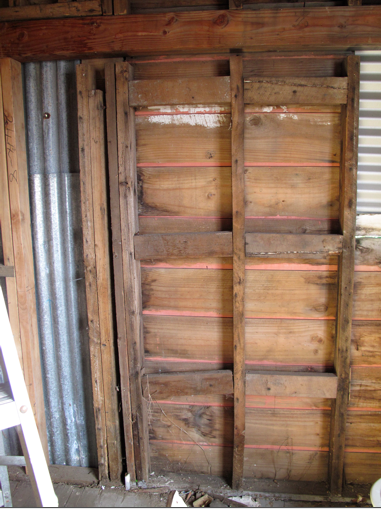 Current wall = future french doors.
 Enjoying a cuppa in the sunny coffee nook.
 For the window we went with second-hand, but the new doors have just been ordered from the local aluminium (that’s right, we now us the extra ‘I’) joinery at a cost of $1,300. Our holistic design approach to gain, absorb and retain the sun’s heat will allow us to recoup the investment in the form of energy savings for years to come. This is the heart of what is called ‘passive solar’ building.
-M.C. Estwing

Subscribe to:
Posts (Atom)